More paddle boarders are ditching inflatables for solid boards, and for good reason.
I’m here to walk you through four standout options that’ll transform how you experience the water, each bringing something unique to the table.
Whether you’re after stability, speed, or versatility, there’s a board here that matches your style.
But before you commit to one, you’ll want to understand what actually sets them apart.
| WAVESTORM 9ft6 SUP Kayak Hybrid Stand Up Paddleboard | Best for Beginners | Maximum Weight Capacity: 200 lbs | Length: 9’6″ (114 inches) | Width: 33 inches | VIEW LATEST PRICE | Read My Analysis | |
| Lifetime Amped Hardshell Paddleboard with Paddle 11′ Glacier Blue | Best Durability | Maximum Weight Capacity: 230 lbs | Length: 11 feet (132 inches) | Width: 32 inches | VIEW LATEST PRICE | Read My Analysis | |
| Professional Surf Ski for Ocean & Flat Water | Best for Performance | Maximum Weight Capacity: 500 lbs (1,102 lbs) | Length: Not specified | Width: 14 inches | VIEW LATEST PRICE | Read My Analysis | |
| Paddle Board Stand Up 11′ Extra Large 450LBS | Best Weight Capacity | Maximum Weight Capacity: 551 lbs (250 kg) | Length: 11 feet (335 cm) | Width: 34 inches (86 cm) | VIEW LATEST PRICE | Read My Analysis |
More Details on Our Top Picks
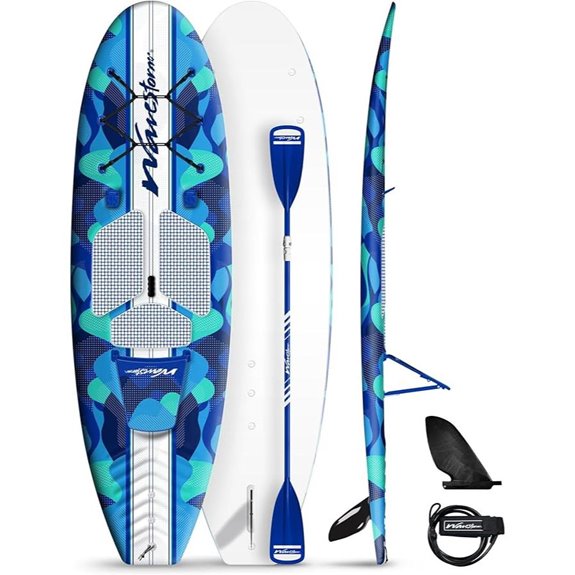
WAVESTORM 9ft6 SUP Kayak Hybrid Stand Up Paddleboard
Want a paddleboard that welcomes you regardless of your experience level? The WAVESTORM 9ft6 SUP Kayak Hybrid delivers exactly that. This foam soft top features an EPS core with three stringers and a water-resistant WBS top deck, giving you a durable, beginner-friendly platform. At 114 inches long and 33 inches wide, it’s spacious enough for both adults and kids, with a 200-pound weight capacity.
You’ll appreciate the included ankle leash and fin, which means you’re ready to paddle straight out of the box. And here’s the kicker: its #199 ranking in Stand-Up Paddleboards proves this hybrid option holds its own among serious competitors. For recreational paddling across skill levels, this board delivers genuine versatility without breaking the bank.
- Maximum Weight Capacity:200 lbs
- Length:9’6″ (114 inches)
- Width:33 inches
- Skill Level:All levels (adults and kids)
- Included Paddle:Yes (included)
- Warranty:30 days
- Additional Feature:EPS foam core with stringers
- Additional Feature:Water Barrier Skin deck
- Additional Feature:Hybrid kayak/paddleboard design
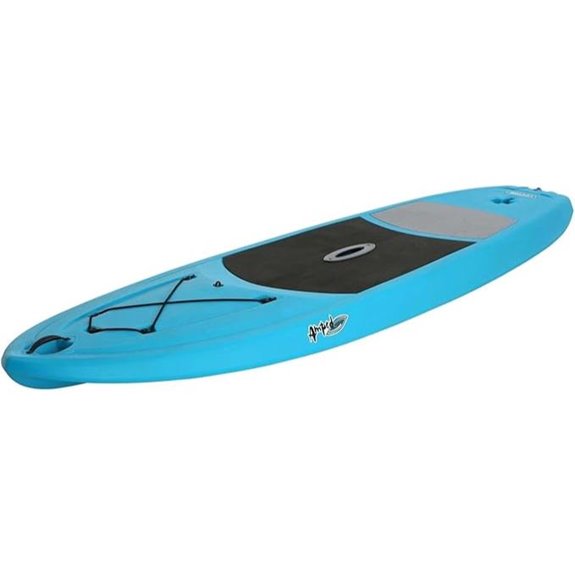
Lifetime Amped Hardshell Paddleboard with Paddle 11′ Glacier Blue
If you’re an intermediate paddler looking for a board that’ll actually last, the Lifetime Amped delivers durability you can count on. This 11-footer weighs 47 pounds and sports high-density polyethylene construction that resists fading, cracking, and peeling. The EVA deck covering gives you solid traction, while the retractable 9-inch fin adapts whether you’re hitting surf or calm water.
You’ll appreciate the front bungee for gear storage and the center carry handle for transport. The included adjustable fiberglass paddle means you’re ready to paddle immediately. With a 230-pound weight capacity and a 5-year warranty backing your investment, you’re getting a reliable workhorse that handles stability and tracking across different conditions.
- Maximum Weight Capacity:230 lbs
- Length:11 feet (132 inches)
- Width:32 inches
- Skill Level:Intermediate paddlers
- Included Paddle:Yes (adjustable fiberglass paddle included)
- Warranty:5 years limited
- Additional Feature:High-density polyethylene construction
- Additional Feature:Retractable 9-inch fin
- Additional Feature:Front deck bungee storage
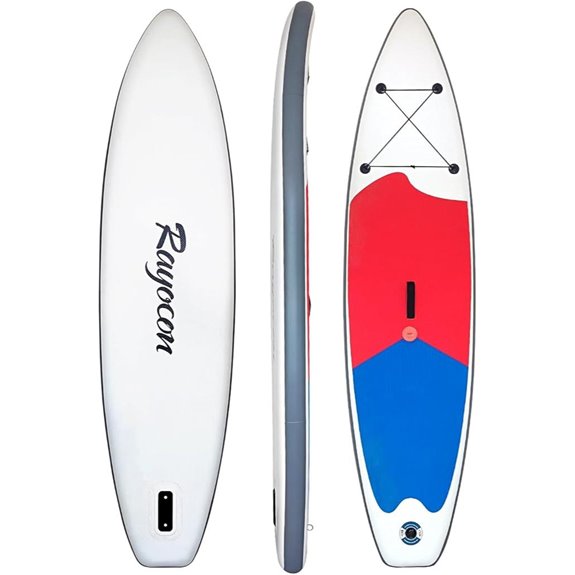
Professional Surf Ski for Ocean & Flat Water
The RAYOCON Professional Surf Ski delivers the kind of performance edge you’re after whether you’re chasing speed or endurance. This lightweight paddleboard measures 37 inches long by 14 inches wide, making it nimble enough for quick maneuvers yet stable enough for beginners. Built from durable plastic with a 500-kilogram weight capacity, you get serious durability without the heft.
The ergonomic seating design keeps you comfortable during extended paddles, while the sleek hull glides smoothly across both ocean swells and calm flatwater. Whether you’re training for racing, building fitness, or simply enjoying recreational paddling, this surf ski offers a responsive kayak alternative that won’t leave your shoulders aching.
- Maximum Weight Capacity:500 lbs (1,102 lbs)
- Length:Not specified
- Width:14 inches
- Skill Level:Beginners to professionals
- Included Paddle:Not specified
- Warranty:1 year manufacturer
- Additional Feature:Sleek, fast design
- Additional Feature:Ergonomic seating for distance
- Additional Feature:Ocean & flat water
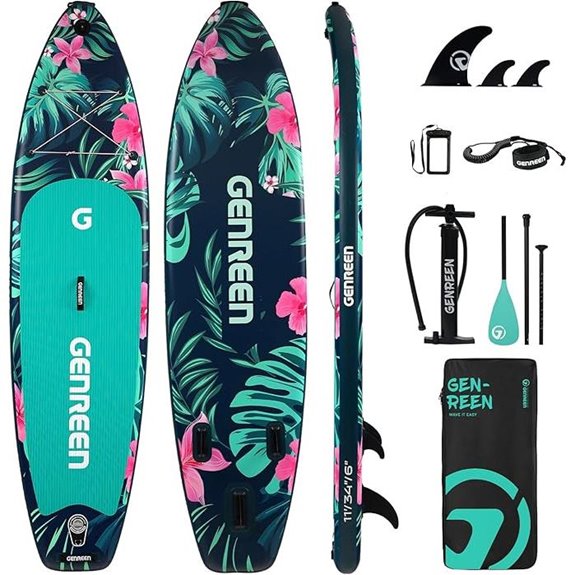
Paddle Board Stand Up 11′ Extra Large 450LBS
Looking for a paddle board that won’t buckle under the weight of multiple adults, your crew, and all your gear? The GENREEN 11x34x6 delivers serious capacity with its 551-pound weight limit, making it perfect for families or group adventures. Its 34-inch width provides stability that beginners and yoga enthusiasts appreciate, while the premium double-layer PVC construction with reinforced drop-stitch resists cracks and leaks through rigorous testing.
You’ll appreciate the included aluminum paddle, triple fins for maneuverability, and integrated camera mount for capturing moments. The 0.3 to 0.5 centimeter anti-slip EVA deck handles pet claws without damage, and the safety leash keeps you connected to your board.
- Maximum Weight Capacity:551 lbs (250 kg)
- Length:11 feet (335 cm)
- Width:34 inches (86 cm)
- Skill Level:All levels (beginners and beyond)
- Included Paddle:Yes (aluminum paddle included)
- Warranty:3 years
- Additional Feature:Premium double-layer PVC construction
- Additional Feature:Three detachable control fins
- Additional Feature:Integrated camera mount
Factors to Consider When Choosing Non Inflatable Paddle Boards 2026
When you’re shopping for a solid non-inflatable paddle board, I want you to focus on five key factors that’ll make or break your investment: the material’s durability and how long it’ll actually last, the weight capacity to ensure it handles your body and gear, the thickness and stability features that affect your balance on the water, how portable it is for getting to and from your favorite spot, and what warranty coverage the manufacturer offers to protect your purchase. And here’s the thing, these aren’t just random specs to ignore, each one directly impacts your experience, safety, and how much value you’re actually getting for your money. By understanding what matters most in these categories, you’ll make a choice that fits your needs instead of just grabbing whatever’s popular.
Material Durability And Longevity
How long will your board actually last? That depends entirely on what you’re working with. I’d look closely at the core materials first.
Hardshell boards with solid cores and integrated fins maintain their rigidity and shape across seasons, while reinforced drop-stitch construction in premium options offers exceptional dimensional stability for frequent paddlers. The coating matters just as much. UV-stable finishes and anti-abrasion edges protect against fading, cracking, and wear from fins and paddles grinding against the deck.
HDPE construction delivers impact resistance without compromising durability. And here’s the thing: foam-top designs rely on rigid shells and stringer configurations to preserve structural integrity through years of handling and storage. Invest in boards featuring these characteristics, and you’re looking at genuinely lasting equipment.
Weight Capacity Specifications
Your board’s durability means nothing if it can’t actually support you and your gear safely. Non-inflatable boards typically range from 200 to 551 lbs capacity, and you’ll find the manufacturer lists this spec prominently for good reason.
Here’s what I consider when evaluating weight limits:
- Your body weight
- Paddle, leash, and accessories
- Additional gear like coolers or fishing equipment
- Dynamic forces during maneuvers or waves
Some builders differentiate between solo use and loaded configurations, while others emphasize higher limits for families. Exceeding capacity compromises stability, speed, and structural integrity, so don’t treat these numbers as suggestions.
Add up everything you’re bringing, include yourself, then choose a board that comfortably exceeds that total. You’ll paddle with confidence knowing you’re within safe parameters.
Thickness And Stability Features
Stability on the water comes down to a few interconnected design elements, and thickness ranks right up there with width and volume as a critical factor. I’ve found that boards around 4.5 inches thick deliver superior rigidity and better weight capacity than thinner alternatives, which means less flex underfoot when you’re shifting your stance. That rigidity matters especially for beginners trying to lock in their balance.
But thickness doesn’t work alone. A wider deck combined with solid volume creates that planted, confident feeling you want. Non-inflatable boards with HDPE cores and internal stringers maintain their structure beautifully across varying water conditions. Pair a broader beam with adequate thickness, and you’re looking at steady tracking and genuine resistance to tipping. That’s the stability sweet spot.
Portability And Transport Ease
When you’re hauling a paddle board to the water, weight and bulk become your real concerns, and that’s where non-inflatable boards present a genuine trade-off. Most rigid boards weigh between 47 and 55+ pounds, so built-in carry handles and quality roof racks become essential.
You’ll want to focus on:
- Center carry handles for easier lifting
- Compact dimensions (around 11 to 11.5 feet long, 32-34 inches wide)
- Detachable or foldable fins to reduce overall footprint
- Durable construction materials like HDPE or rigid foam cores that resist damage during transport
While non-inflatables require more vehicle space and physical effort than their inflatable cousins, smart design features streamline the entire process from home to water considerably.
Warranty Coverage Options
How much peace of mind matters to you when dropping serious cash on a rigid paddle board? I’d say it matters plenty, which is why warranty coverage deserves your attention.
You’ll find warranty terms varying considerably across brands. Some boards come with modest 30-day coverage, while others offer sturdy 5-year limited warranties protecting against defects in materials and workmanship.
Here’s what typically matters:
- Coverage length and scope
- Original purchaser requirements
- Registration or proof of purchase needs
- Regional support availability
Most warranties exclude normal wear, misuse, and damage from improper storage or handling. And honestly, that’s fair. Some brands provide Japanese customer support or regional service centers, which can be valuable if issues arise.
Before committing, check whether your board’s warranty aligns with your expected usage and where you’ll need support.
Skill Level Compatibility
Your paddle board choice should match where you’re at right now, not where you hope to be in six months. Beginners need wider boards (30–34 inches) with thicker profiles (4–6 inches) to build confidence through stability. As you progress, you’ll want boards with better tracking and hull designs that maintain straight lines effortlessly, plus fixed fin setups that reduce frustration.
Intermediate paddlers benefit from rigid construction that responds to your growing skills. If you’re speed-focused, you’ll crave stiffer, high-density materials and streamlined shapes designed for efficiency rather than beginner-friendly features. And here’s the thing: weight capacity matters too. Underestimating it sabotages stability and performance, especially on longer boards.
Match your skill level honestly, and you’ll actually enjoy paddling instead of fighting your equipment.
Water Condition Suitability
Choosing the right board for where you’ll actually paddle matters just as much as matching your skill level, because even the best-constructed rigid board won’t perform well if it’s fighting against choppy water or struggling in flat conditions. A hardshell’s rigid hull gives you consistent performance across different water types, while its integrated fin system handles edge control beautifully.
I’d pay attention to width and length: wider decks around 34 inches give you stability in calm water but sacrifice maneuverability in waves, whereas narrower boards track better through chop. Your fin configuration matters too. Retractable fins let you adjust for varying conditions, giving you smoother glide in flat water and better wave control when conditions shift. That flexibility is worth considering.
Included Accessories Value
Once you’ve settled on a board that matches your water conditions, what comes in the box matters more than you might think. I’ve found that comprehensive accessory kits significantly impact your setup experience and long-term value.
Look for these essentials:
- Quality paddle (fiberglass outperforms aluminum for weight and performance)
- Ankle leash for safety
- Fins for maneuverability
- Pump for inflation-ready boards
- Repair patches and storage bag
A carrying handle or dedicated transport bag transforms portability beyond the board itself. Adjustable paddles deserve attention since they accommodate different heights and preferences, reducing frustration for new users.
And here’s the thing: boards bundled with pumps, extra fins, and maintenance supplies enable you to handle repairs independently and experiment with different setups. That upfront investment in accessories pays dividends when you’re actually on the water.